China’s intelligent stage-lighting sector is moving beyond brighter fixtures and faster color changes. The next shift is toward connected systems that combine LED engines, moving heads, sensors, control consoles, and show software. PwC’s Global Entertainment & Media Outlook 2024–2028 projects continued growth in global entertainment and media revenue. This broader outlook signals a changing market, but it does not measure demand for stage lighting alone. That distinction matters.
What is the future trend of intelligent stage lighting? In China, likely priorities include networked control, lower energy use, quieter fixtures, and simpler integration across venues. A touring production may need the same cue to trigger reliably across different stages, while a theater operator may value accurate color and quick maintenance. These practical needs can matter more than a long feature list. ESTA’s technical resources and standards also underline the importance of interoperability and safe, dependable system design.
Automation and AI may help teams organize cues or adapt lighting to a performance, but they will not replace skilled lighting designers. Data quality, staff training, and compatibility remain real constraints. The picture is still uneven. Some venues can invest in advanced networks; smaller spaces may need durable fixtures and straightforward controls first. This article examines the trends shaping China’s market, the technologies behind them, and the trade-offs buyers should assess before choosing an intelligent lighting system.
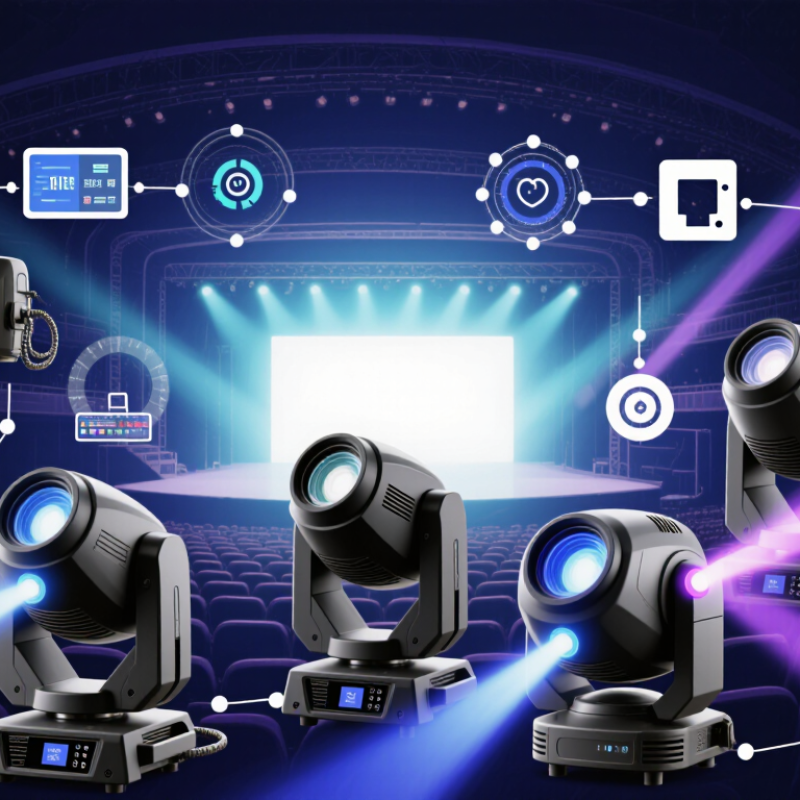
Intelligent stage lighting is a connected system for creating, controlling, and adapting light during live performance. It can include LED fixtures, moving lights, control consoles, network protocols, sensors, and software. Together, these tools let operators adjust color, brightness, position, and timing from a shared control environment. A fixture alone is not necessarily “intelligent.” The system’s ability to receive commands, exchange data, and respond predictably matters more.
Its scope runs from programming and rehearsal to show playback, monitoring, and maintenance. DMX512 remains common for fixture control, while network-based systems can carry more data across complex venues. The boundary is fuzzy. Some automated lights offer little feedback, while simpler setups may use sensors and programmed cues effectively. Fortune Business Insights valued the broader global smart-lighting market at USD 15.05 billion in 2023 and forecast USD 79.06 billion by 2032. That estimate covers many applications, not stage lighting alone, so it should not be treated as a stage-market figure. For venue planners, the practical test is whether a system improves repeatability, response time, and safe operation without making troubleshooting harder. More connectivity is not always better.
Intelligent stage lighting combines electronically controlled fixtures with programmable color, intensity, movement and beam effects. This chart shows approximate visible-light wavelength ranges, a useful reference for understanding LED color mixing and tunable light. Boundaries between color bands vary by reference; the chart describes the visible spectrum, not market forecasts.
China Top Intelligent Stage Lighting Future Trends?
China’s Intelligent Stage Lighting Industry Landscape
China’s intelligent stage-lighting landscape is closely tied to live performance activity. The China Association of Performing Arts reported about 440,000 commercial performances in 2023, generating roughly RMB 50.2 billion in box-office revenue and attracting 155 million audience visits. These figures describe the wider performance market, not lighting sales, but they indicate the scale of venues and productions that may need modern lighting systems. Demand comes from touring concerts, theatres, festivals, and smaller multi-purpose halls. Their practical needs differ: a touring rig must travel efficiently, while a theatre may prioritize quiet operation and precise cue control.
LED fixtures, networked control, and automated moving lights are making rigs more adaptable. A lighting designer can shape a warm wash across a stage, then redirect narrow beams within seconds. Yet “intelligent” does not automatically mean easier. Older consoles, mixed equipment, staff training, and maintenance can complicate upgrades. Smaller venues may also struggle to justify a full system replacement. This picture is incomplete: public performance data cannot reveal how much venues spend on lighting, or how quickly they adopt new systems.
Tips: Before upgrading, test fixture compatibility, control protocols, and service access in the actual venue. Ask operators to rehearse common cues. A reliable setup matters more than feature count.
China Top Intelligent Stage Lighting Future Trends?
Core Technologies Behind Intelligent Stage Lighting
Intelligent stage lighting combines efficient LED sources, precision optics, control networks, and software. Each part shapes what audiences see. A bright fixture is not enough. Its beam must stay consistent, colors should blend smoothly, and movement must remain quiet and repeatable. Heat management matters, too. Poor cooling can shorten component life and shift color output during long shows.
Control systems connect lighting consoles, fixtures, and sensors through established protocols such as DMX and RDM. Networked control can support faster configuration and remote status checks, but a crowded network may introduce delays. Careful addressing and testing help prevent surprises. Sensors can respond to position or ambient conditions, while software coordinates cues and moving mechanisms. Automation helps. It does not replace judgment. Operators still need clear manual controls and tested fallback settings. A useful test is simple: run a cue repeatedly, then inspect beam edges, color consistency, and response time. Small inconsistencies may be easy to miss in a quiet workshop, yet obvious on a large stage. The technology is advancing, but reliability still depends on thoughtful setup.
China’s intelligent stage-lighting demand is expanding across touring concerts, theaters, festivals, and cultural-tourism venues. The China Association of Performing Arts reported about 440,000 commercial performances and RMB 50.2 billion in box-office revenue in its 2023 National Performance Market Development Brief. These figures indicate a larger live-event base, though they do not directly measure lighting sales. The numbers matter. More frequent shows mean tighter changeovers, repeatable cues, and reliable fixtures. Operators increasingly value networked control, moving lights, and programmable LED systems that can reshape a stage quickly.
Growth also comes from venue upgrades and hybrid production. A theater can reuse stored lighting scenes, while a livestream studio may need precise, flicker-conscious illumination for cameras. LEDs can reduce power demand and lamp changes, but savings depend on equipment, workload, and maintenance. Adoption is not frictionless. Smaller venues may lack skilled technicians or budgets for full system upgrades. China’s market outlook therefore depends not only on new fixtures, but also on training, service support, and practical integration with existing rigs. Event activity is a useful demand signal, not a complete forecast.
| Market Dimension | Typical Applications in China | Relevant Data or Technical Indicator | Factors Supporting Market Growth | Likely Future Direction |
|---|---|---|---|---|
| Live entertainment and touring | Concerts, music festivals, touring productions, and large event venues | DMX512-A provides up to 512 data slots per universe. Larger rigs can distribute control across multiple universes and networked nodes. | Demand for adaptable show designs, faster setup and control of larger fixture systems | More network-based distribution, reusable show files, pixel-mapped effects, and automated fixture workflows |
| Theatres and performing arts venues | Professional theatres, opera houses, cultural centers, and multipurpose auditoriums | RDM, defined by ANSI E1.20, supports bidirectional communication over compatible DMX512 systems for device discovery and remote configuration. | Investment in venue upgrades and the need for precise, repeatable lighting across different productions | Greater use of remotely monitored fixtures, preset-based operation, and integration with venue control systems |
| Broadcast and studio production | Television studios, livestreaming facilities, and production stages | LED fixtures can provide electronic dimming and color adjustment; actual output, color quality, and power use vary by fixture and operating conditions. | Flexible studio layouts, changing production formats, and demand for consistent on-camera lighting | More software-managed presets, camera-aware lighting workflows, and networked fixture monitoring |
| Theme parks and immersive attractions | Theme parks, immersive shows, interactive exhibits, and indoor entertainment spaces | Time-coded cues and synchronized control can coordinate lighting with audio, video, and show automation; the implementation depends on the venue system. | Demand for repeatable, synchronized visitor experiences and frequently refreshed content | Expanded use of synchronized media control, spatial effects, and sensor-triggered scenes |
| Architectural and event spaces | Exhibition halls, convention centers, cultural buildings, and temporary event spaces | ANSI E1.31 (sACN) carries DMX512 data over IP networks, enabling network distribution where compatible equipment and configuration are used. | Multi-use venues need lighting systems that can be reconfigured for different events | More IP-based control, flexible zoning, and integration with building or event-management systems |
| Control software and automation | Production control rooms and venues operating complex lighting rigs | Art-Net and sACN are commonly used protocols for transporting lighting-control data over Ethernet networks; network design and device compatibility matter. | More fixtures and effects increase the value of centralized configuration, monitoring, and cue management | Improved interoperability, clearer network diagnostics, and more automated setup and show operation |
| Energy and lifecycle management | Permanent installations and frequently used performance venues | LED technology enables electronic dimming and color mixing. Energy savings depend on fixture efficiency, operating hours, output settings, and the system being replaced. | Operators consider electricity use, maintenance requirements, and equipment replacement costs over time | More attention to measured energy performance, repairability, and lifecycle cost rather than fixture price alone |
| Skills and system integration | Venues, rental operations, production companies, and technical training programs | Reliable operation depends on compatible fixtures, control protocols, network configuration, commissioning, and trained operators. | More sophisticated systems require skilled programming, maintenance, and technical support | Greater demand for integrated training, documented system design, and remote troubleshooting capabilities |
China’s stage-lighting sector is growing alongside live performance, but smarter fixtures alone will not solve its challenges. The China Association of Performing Arts reported about 440,000 commercial performances and 20.8 billion yuan in box-office revenue in 2023, excluding entertainment venues. That activity creates demand for adaptable rigs, precise dimming, and faster venue changeovers. Yet budgets and technical staffing vary widely. A compact theatre may need quiet, low-heat fixtures, while an outdoor show faces dust, rain, and long cable runs.
Intelligent control brings practical gains, but integration remains uneven. Lighting desks, network protocols, legacy dimmers, and moving fixtures must work together under pressure. A single lagging cue can break a scene. Energy use also matters: LED systems can reduce load, but savings depend on programming, maintenance, and replacement cycles. Operators need training, not just new equipment. This part is easy to underestimate. As the 2023 performance figures suggest, rising activity does not automatically mean every venue can afford a full upgrade.
It connects fixtures, controls, sensors, and software in one system. A fixture alone is not enough. The system must respond predictably.
Systems may combine LED fixtures, precision optics, moving mechanisms, control consoles, sensors, and software. Each part affects what audiences see.
DMX512 remains common for fixture control. Networked systems can carry more data and support remote status checks, but poor setup may cause delays.
Operators can save cues and repeat them across performances. This helps with quick changeovers. More connectivity is not always better.
Run the same cue several times. Check beam edges, color consistency, movement, and response time. Small flaws can stand out onstage.
It supports concerts, theaters, festivals, cultural-tourism venues, and livestream studios. Camera work may need steady, flicker-conscious illumination.
An industry report recorded about 440,000 commercial performances and RMB 50.2 billion in box-office revenue in 2023. These figures suggest a larger event base, not lighting sales.
They can lower power use and reduce lamp changes. Actual savings depend on equipment, workload, and maintenance. That part is easy to overlook.
Budgets and limited technical staff can slow upgrades. Training, service support, and practical integration matter. New equipment alone may not solve everything.
Intelligent stage lighting combines automated fixtures, digital control systems, sensors, and software to create responsive, precisely coordinated lighting for live performances and events. In China, the sector is developing alongside expanding entertainment venues, cultural events, touring productions, and demand for immersive audience experiences. Advances in LED sources, networked controls, data processing, and interactive technologies are making lighting systems more flexible, energy-conscious, and easier to integrate with sound and visual effects.
What is the future trend of intelligent stage lighting? The industry is likely to move toward greater automation, real-time responsiveness, wireless connectivity, and more personalized designs, while improving efficiency and system reliability. Opportunities will depend on continued technical innovation and a skilled workforce. Challenges include equipment and integration costs, compatibility across systems, and the need to balance increasingly complex effects with dependable operation.

Senning Lights