Choosing the right LED stage lights for events is crucial. The decision often boils down to two categories: indoor and outdoor. Understanding how to choose between indoor and outdoor LED stage lights can significantly impact the event's atmosphere and success.
According to industry reports, the global LED lighting market is projected to reach $160 billion by 2026. This growth underscores the increasing importance of quality lighting in event production. Indoor LED lights, typically brighter and more versatile, excel in controlled environments. Conversely, outdoor LED lights must withstand various weather conditions, making durability a key factor.
It's essential to consider the event type and location. Outdoor events may require lights with a higher IP rating for water resistance and robustness. On the flip side, indoor settings often allow for softer, more intricate lighting arrangements. Each choice carries its own set of uncertainties. Therefore, knowing how to balance aesthetics and functionality is critical for any event organizer. Reflection on previous experiences can also guide better decision-making in future events.
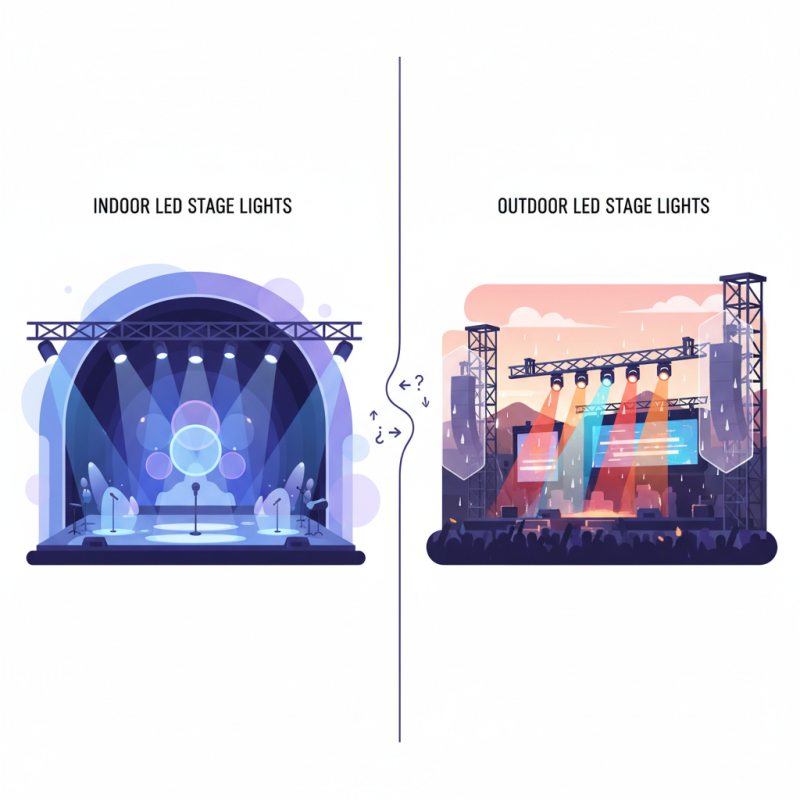
When selecting LED stage lights for events, it's crucial to understand the distinctions between indoor and outdoor models. Indoor LED lights are designed for controlled environments. They focus on color accuracy and even illumination, essential for indoor performances. A report by the Lighting Research Center states that indoor lights can produce higher color rendering indexes (CRI), often above 90. This ensures that colors appear vibrant under stage lighting.
In contrast, outdoor LED stage lights must withstand various weather conditions. They feature more robust housing and protective measures against moisture and dust. According to industry insights, outdoor lights typically have an ingress protection (IP) rating of at least IP65. This level signifies that the fixtures can resist water jets, making them suitable for open-air events. However, many users overlook factors like brightness. Outdoor lights often need higher lumen output to compete with natural light.
Some may argue that indoor lights can be adequate for semi-outdoor settings. But this can lead to poor performance in fluctuating light conditions. Hence, investing in the right type can prevent costly setup issues. Quality lighting plays a vital role in audience experience, impacting mood and engagement. Therefore, while cost and convenience are valid considerations, the choice between indoor and outdoor LEDs should prioritize performance and safety standards.
: Indoor lights focus on color accuracy, while outdoor lights need to withstand diverse weather conditions.
Indoor LEDs with high CRI ensure that colors look vibrant during performances, enhancing visual quality.
Outdoor lights should have an IP rating of at least IP65 to resist water and dust.
While possible, using indoor lights outdoors can result in poor performance in changing light conditions.
Rain and humidity can damage non-weatherproof lights, impacting the performance of your setup.
Poor placement can create unwanted shadows and disturb local wildlife, affecting the overall experience.
Choosing energy-efficient lights can lower costs and reduce environmental impact during long events.
Good lighting affects mood and engagement, making quality a priority over cost and convenience.
Ignoring performance needs can lead to costly setup issues and a negative audience experience.
Evaluating the setup and surroundings aids in selecting effective lighting that reaches the audience well.
When considering how to choose between indoor and outdoor LED stage lights for events, it's essential to understand the differences between the two. Indoor LED lights are designed for controlled environments, providing optimal brightness and color temperatures, while outdoor lights need to withstand weather conditions and offer wider beam angles for broader coverage.
Key factors include evaluating brightness, color temperature, and beam angle to ensure the lighting suits your event's needs. For outdoor settings, assess environmental considerations to ensure durability and performance under varying conditions. Lastly, budgeting plays a crucial role; finding cost-effective solutions that maintain quality will help meet your lighting needs without overspending.

 Senning Lights