LED stage lights have revolutionized the entertainment industry, but achieving color accuracy remains a challenge. Understanding what factors affect the color accuracy of LED stage lights is crucial for designers and technicians. According to Dr. Emily Raines, a lighting technology expert, “Even slight variations in LED components can lead to significant changes in perceived color.” Her insight underscores the complexity of the task.
One key factor impacting color accuracy is the quality of LED chips. Higher-quality chips tend to produce truer colors. Additionally, the design of the fixture itself can influence how light interacts with surfaces. Poorly designed optics may scatter light unevenly, leading to color distortion. The environmental conditions during a performance, like ambient light and stage materials, also significantly affect how colors appear to the audience.
Despite advancements, issues remain. The variance in manufacturing processes can lead to inconsistencies. Technicians must continually adapt to these challenges. Compromises often arise when balancing cost and quality. The journey to perfect color accuracy is ongoing, reflecting both the potential and imperfection of modern lighting technology.
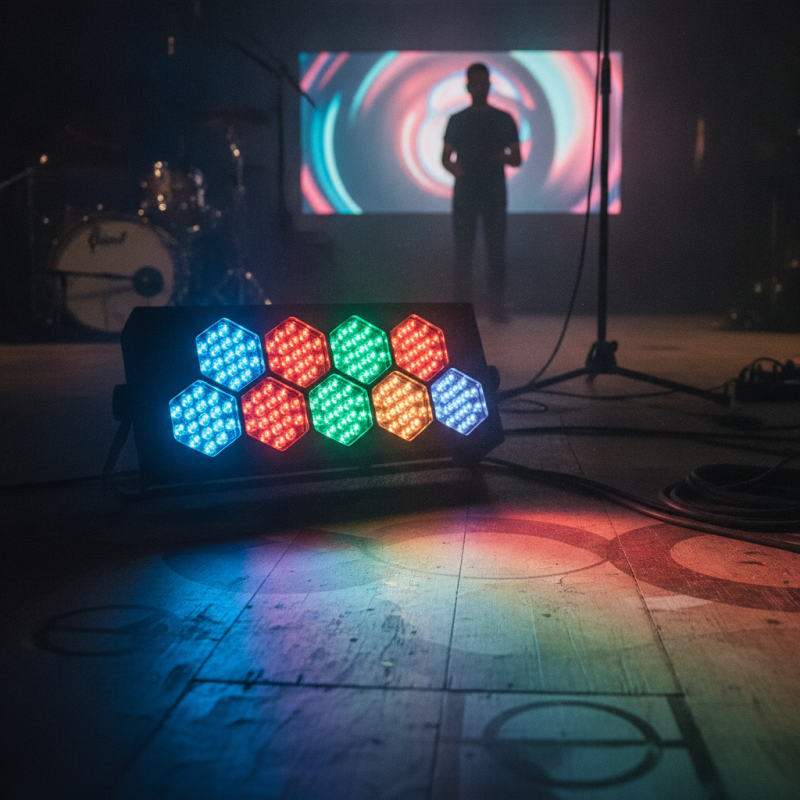
The design of LED light sources is pivotal for achieving precise color accuracy in stage lighting. Factors like the LED chip composition and the phosphor coating on the LEDs significantly influence color rendition. Research indicates that the color rendering index (CRI) can vary dramatically with different materials. For instance, some LEDs can have a CRI as low as 70, while others exceed 95. Such discrepancies can alter how colors appear on stage, impacting the audience’s experience.
Thermal management is another critical element. LEDs generate heat, which can shift the color temperature when not adequately dissipated. High temperatures can lead to color drift, changing the original hue. A study conducted by the Lighting Research Center showed that for every increase of 10 degrees Celsius, the LED's color output could deviate by up to 3%. This emphasizes the need for efficient heat sinks and designs that maintain optimal operating temperatures.
The interplay between individual LED characteristics also matters. Not all light emitted from an LED contributes evenly to visible color. Often, blue-rich LEDs are utilized for their intensity but may lead to an imbalance in warmer tones. Balancing these aspects is challenging. It highlights an area where further development is necessary to improve overall performance and accuracy in stage lighting. Continuous innovation is essential to address these design vulnerabilities.
| Factor | Description | Impact on Color Accuracy | Measurement Technique |
|---|---|---|---|
| LED Chip Quality | The purity and material quality of the LED chip | Highly affects the consistency of emitted colors | Spectrophotometry |
| Color Calibration | Adjusting light output to match color standards | Essential for accurate color rendering | Colorimeters |
| Wavelength Compatibility | Matching wavelengths to visible spectrum ranges | Influences perceived color intensity and accuracy | Quantum Dot Measurement |
| Thermal Management | Heat dissipation mechanisms in LED design | Prevents color shifts due to overheating | Thermal Imaging |
| Optical Components | Lenses and filters used to shape light output | Can enhance or distort color rendering | Goniophotometry |
: Color temperature, measured in Kelvin (K), affects light's warmth or coolness.
Warmer lights, around 2700K, evoke comfort. Cooler lights create excitement and tension.
It enhances audience experience and brings performances to life, ensuring emotional engagement.
Dimming can shift color temperature and hue, leading to inconsistencies in color output.
PWM (Pulse Width Modulation) and analog dimming are common techniques, each with drawbacks.
Calibration addresses variations in LED technology and ensures accurate light output.
Technicians often use color spectrometers to analyze and adjust LED lights accurately.
Many professionals overlook recalibrating, which can lead to ongoing color inaccuracies.
It automates calibration, ensuring accuracy, but can lead to complacency among users.
Yes, over-reliance on software may diminish hands-on expertise, impacting overall quality.
The accuracy of color reproduction in LED stage lights is influenced by several critical factors. Understanding what factors affect the color accuracy of LED stage lights begins with the design of the light source itself, where various elements such as LED chip quality and color mixing techniques play significant roles. Additionally, color temperature is essential for maintaining a consistent performance, significantly affecting how colors are perceived in different lighting scenarios.
Furthermore, the spectral distribution of emitted light has profound effects on color representation, as it determines how accurately colors can be rendered on stage. Dimming characteristics also contribute to color fidelity, as the performance can vary at lower intensities. Finally, calibration techniques are crucial for ensuring that LED lights reproduce colors accurately, enabling a vibrant and true-to-life experience for audiences. Collectively, these factors underscore the complexity of achieving optimal color accuracy in LED stage lighting.

 Senning Lights