Concert lighting has evolved far beyond simple brightness and color changes. Today, intelligent fixtures can move, focus, dim, and reshape a venue within seconds. They help transform a quiet stage into a vivid visual environment that supports the artist’s music and performance.
Why is intelligent stage lighting popular in concerts? The answer combines flexibility, precision, and audience engagement. Modern lighting systems can follow performers, highlight instruments, and create timed effects with remarkable accuracy. A moving beam can sweep across thousands of fans. A soft backlight can make a singer appear almost three-dimensional. These details give live performances a stronger identity and emotional rhythm.
Lighting designers also value intelligent systems because they offer practical control during complex shows. Programmable scenes allow technicians to manage different songs, venues, and performance moments efficiently. Experienced teams can adjust brightness, color temperature, and movement to protect visual comfort. They must also consider camera exposure, stage safety, and audience sightlines. Bright effects are not always better. Sometimes, a restrained cue creates greater impact.
The technology is impressive, but it is not a complete solution. Poor programming can make a concert feel chaotic or exhausting. Equipment costs, maintenance demands, and operator skill still matter. In my view, the best results come from balance. Intelligent lighting should strengthen the music, not compete with it. When carefully designed, it becomes an active storytelling tool rather than background decoration.
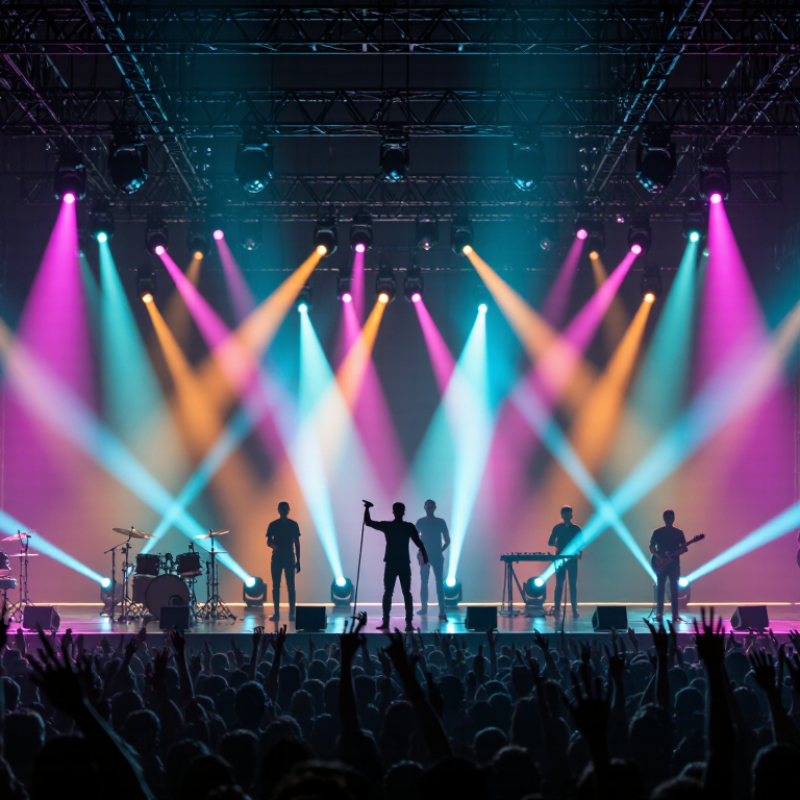
Intelligent lighting means computer-controlled light used as a creative production system. Fixtures can change color, direction, brightness, and movement through programmed cues. Operators often connect them through DMX512 or network-based control protocols. This turns lighting into a timed performance layer, not simple stage decoration.
In a concert workflow, lighting designers build scenes around music, camera angles, and performer movement. A single cue may narrow a beam onto a vocalist, then spread color across the audience. According to Grand View Research’s 2024 smart lighting report, the global smart lighting market was valued at approximately $20 billion in 2023. Its projected growth reflects wider demand for connected, programmable systems. Concert production benefits from the same control logic.
The timing must feel intentional.
Energy performance also matters. The U.S. Department of Energy reports that LED lighting can use at least 75% less energy than incandescent lighting and last much longer. That can reduce heat, power demand, and replacement work during touring. Still, intelligent lighting is not automatically effective. Over-programmed movement can distract from the performer, while excessive brightness can weaken camera images. My experience with cue planning suggests restraint often looks more professional. The technology is powerful, but human judgment remains uneven.
Intelligent lighting systems work through a control network, usually using DMX512-A or sACN. A lighting console sends timed commands to every fixture. Motors adjust pan and tilt, while LED engines change color, intensity, beam angle, and texture. A single cue can turn a warm amber wash into a narrow blue beam within seconds. It feels almost physical.
The system also responds to music, video, and stage movement. Programmers build cues, presets, and timed sequences before the audience arrives. During a concert, operators refine those cues from the control position. The 2024–2028 Global Entertainment and Media Outlook places global live-music revenue near 34 billion dollars in 2023, with forecasts approaching 40 billion dollars by 2028. Larger productions demand repeatable visual control. Precision matters.
Energy use matters too. The U.S. Department of Energy’s 2023 Solid-State Lighting R&D Opportunities report identifies LED efficacy above 200 lumens per watt in advanced laboratory conditions. Real fixtures perform lower. That difference is important. Intelligent systems can reduce heat, power demand, and manual repositioning, but efficiency depends on programming and maintenance. More fixtures do not guarantee better design. A poorly timed movement can distract from a singer, even when the equipment is technically impressive. The human decision remains the weak point.
Why do concerts use intelligent lighting? Visual impact is the central answer. Moving fixtures can shape attention without stopping the performance. During a chorus, narrow beams can sweep above the crowd, while soft washes reveal performers’ faces. Color changes also support musical structure, from cold blue verses to intense red peaks.
PwC’s Global Entertainment & Media Outlook 2024–2028 projects live music revenue to grow from roughly US$33 billion in 2023 to US$40 billion in 2028. That growth increases pressure to create memorable, shareable experiences. Intelligent lighting helps achieve this with programmable movement, color mixing, dimming, and precise timing. Grand View Research also projects continued growth in the global stage-lighting market, supported by LED systems and automated control. The figures suggest strong demand, but they do not prove that bigger lighting always creates better concerts.
Good design still depends on restraint. A lighting programmer may leave one side of the stage dark, then reveal the drummer with a single focused beam. That pause can feel more powerful than constant movement. Sensors and timecode improve consistency, yet live conditions remain unpredictable. Fog density changes. Cameras need balanced exposure. Audience reactions can also challenge the original plan. The effect is not automatic. Concert teams must test angles, brightness, transitions, and sightlines during rehearsal. Sometimes, less light communicates more.
| Data Dimension | Relevant Technical Data | How It Creates Visual Impact | Why Concerts Use It |
|---|---|---|---|
| Lighting Control Capacity | DMX512 supports up to 512 control slots per universe, allowing parameters such as intensity, color, focus, movement, and effects to be controlled digitally. | Many lighting parameters can be coordinated as one synchronized visual sequence. | Complex lighting scenes can be programmed, recalled, and repeated consistently throughout a performance. |
| Control Refresh Rate | DMX512 uses a serial data rate of 250 kbit/s. The practical refresh rate depends on the number of transmitted channels and the control system. | Frequent control updates support responsive fades, chases, color changes, and movement effects. | Lighting can react closely to musical transitions, drum hits, and programmed timecode. |
| Color Flexibility | RGB and RGBW LED systems create colors through additive mixing. RGBW adds a dedicated white channel for improved white-light quality and intensity. | Color palettes can shift from subtle tones to saturated concert looks without replacing physical gels. | One fixture can perform multiple visual roles, reducing the need for separate fixtures for every color. |
| Dimming and Intensity Control | Digital fixtures provide continuously adjustable intensity levels, subject to the fixture design and control resolution. | Blackouts, flashes, slow fades, and intensity accents can be timed precisely with the performance. | Dynamic contrast makes key musical moments more noticeable and improves visual pacing. |
| Automated Movement | Moving fixtures combine electronically controlled pan and tilt with programmable intensity, color, beam, and focus functions. | Beams can sweep across the stage, audience, and venue to create depth and kinetic motion. | Movement changes the composition continuously without manually repositioning each fixture. |
| Beam and Gobo Effects | Many intelligent fixtures can modify beam spread and project patterns, commonly called gobos, depending on the fixture type. | Sharp beams, textured projections, and aerial effects add layers to haze-filled spaces. | Lighting designers can create recognizable visual motifs and vary the apparent scale of the stage. |
| Music and Timecode Synchronization | Lighting consoles can trigger cues manually or synchronize cues with musical timing and production timecode. | Changes in color, movement, and intensity can occur at repeatable points in a song or show sequence. | Synchronization strengthens the connection between sound, performance, video, and stage movement. |
| LED Operating Life | LED light sources are commonly rated in the range of 20,000–50,000 hours, depending on the product, operating temperature, drive conditions, and maintenance. | Stable solid-state sources support repeated touring and production use with fewer lamp replacements. | Long service life can reduce maintenance interruptions when fixtures are properly cooled and operated. |
| Energy and Heat Management | LED fixtures generally convert a higher proportion of electrical input into useful light than traditional incandescent sources, while actual savings depend on fixture output, duty cycle, and system design. | Lower heat output can make close-range stage environments more comfortable and can reduce the cooling burden in some venues. | Reduced heat and potentially lower operating consumption are valuable during long rehearsals, tours, and multi-show events. |
| Cue Repeatability | Digital consoles store lighting states, timing, and effect parameters as programmable cues. | The same visual sequence can be reproduced with consistent timing from one performance to the next. | Repeatability is essential for tours, broadcast productions, safety checks, and rehearsed theatrical moments. |
| Scalability | Systems can be expanded with additional fixtures, control universes, network nodes, and fixture parameters. | Small venues can use a limited number of fixtures, while large productions can build layered stage, audience, and architectural looks. | The same control concept can support different venue sizes and production budgets. |
| Audience Engagement | Lighting can be directed toward the stage, audience, ceiling, architecture, or haze, with intensity and timing controlled separately. | Wide-area looks and audience sweeps make spectators feel included in the performance environment. | Interactive visual moments can increase the perceived scale and emotional intensity of a concert. |
| Technical values are general reference values. Actual performance varies according to fixture type, control protocol, venue conditions, programming, maintenance, and production design. | |||
Key Benefits for Performers, Audiences, and Event Teams
For performers, intelligent lighting creates clear visual cues during demanding live shows. Programmable movements can follow entrances, solos, and sudden changes in tempo. A carefully focused beam helps musicians read the stage without facing harsh glare. Adjustable color temperature also supports different moods, from warm acoustic moments to energetic dance sections. In real production work, precise timing matters as much as brightness.
Audiences experience a stronger connection with the music. Light can widen during a chorus, tighten during a solo, or move gently across the venue. These changes make large spaces feel more responsive. Smooth transitions are important. Sudden flashes may excite some viewers but overwhelm others, especially people sensitive to intense brightness. Thoughtful programming should include calmer scenes and clear escape routes.
Event teams gain practical control through stored cues, sensor feedback, and centralized adjustments. Technicians can prepare several lighting states before rehearsals, reducing repeated manual changes. Efficient fixtures may also lower power use and reduce heat near the stage. Still, intelligent systems are not automatically intelligent. Sensors can misread movement, and excessive effects can distract from the performers. Human review remains essential, particularly when the venue, audience size, or stage design changes.
Top Reasons Intelligent Lighting Is Popular at Concerts?
Intelligent lighting choices begin with the venue, not the fixture list. A compact club needs controlled beams and low heat. An outdoor stage demands weather protection, stronger output, and reliable signal connections. Designers also study the audience’s viewing angles. A sharp beam may look powerful from the center, but disappear from the side. Color accuracy matters when cameras record performers. Skin tones should remain natural under changing colors.
During rehearsals, lighting teams test movement speed, beam focus, dimming quality, and control response. I have seen a dramatic color change lose its impact because the transition felt too slow. Small details matter. A quiet pan can support a singer’s movement without distracting attention. Fast effects suit energetic sections, but constant motion quickly becomes tiring. Less can be more.
Budget and crew experience also influence the final system. Advanced fixtures may offer more functions, yet complicated programming can create delays during setup. Power consumption, rigging weight, maintenance access, and spare equipment deserve careful review. Safety checks must cover cables, mounting points, heat, and emergency procedures. I sometimes prefer a simpler design because it is easier to operate under pressure. That choice may look less impressive on paper, but it can perform better when timing, weather, or equipment problems change the plan.
It shapes attention without interrupting the performance. Narrow beams can sweep above the crowd during a chorus. Soft washes can reveal performers’ faces. The effect is not automatic.
Color, movement, and brightness can follow the music. Cold blue may suit a quiet verse. Intense red can mark a powerful peak. Sometimes, less movement feels stronger.
Programmable cues can mark entrances, solos, and tempo changes. Focused beams help musicians see the stage without harsh glare. Warm light may support acoustic sections. Timing matters as much as brightness.
Light can widen across a chorus or tighten around a solo. These changes make large venues feel more responsive. Sudden flashes may overwhelm sensitive viewers. Calmer scenes are necessary.
Teams should test brightness, angles, transitions, and sightlines during rehearsal. They should also check sensor feedback and stored cues. Fog can change beam visibility. Cameras need balanced exposure.
A small club may need controlled beams and low heat. An outdoor stage needs weather protection and stronger output. Designers must study side views, not only the center. A strong beam can disappear from an angle.
Budget, crew experience, power use, rigging weight, and maintenance access all matter. Complex fixtures may create setup delays. Spare equipment can reduce disruption. A simpler system may work better under pressure.
Constant motion can distract audiences from the performers. A single beam can reveal a drummer after a dark pause. I have seen dramatic color changes lose impact through slow transitions. Not every impressive idea works live.
Intelligent lighting has become a popular part of concert production because it combines creative design with precise technical control. Unlike basic stage lights, intelligent fixtures can move, change colors, adjust beams, create patterns, and respond to music or performance cues. Through control systems and programmed scenes, lighting teams can coordinate these effects with video, sound, and stage movement, transforming the venue into an immersive visual environment. This explains why is intelligent stage lighting popular in concerts: it helps turn live performances into memorable experiences rather than simple audio events.
For performers, intelligent lighting can highlight key moments, support choreography, and strengthen the atmosphere of each song. Audiences benefit from greater visual excitement, emotional engagement, and a stronger connection with the show. Event teams also gain flexibility, efficiency, and the ability to reuse programmed designs in different venues. When selecting an intelligent lighting system, organizers must consider venue size, stage layout, event budget, fixture capabilities, control compatibility, installation requirements, power use, and the desired artistic effect.
Senning Lights